
Stanley Cup
 Available in US

The Stanley Cup represents the ultimate prize in professional hockey, and for bettors, it represents something equally compelling: months of betting opportunities that begin before the first puck drops in October and do not end until someone hoists the Cup in June. Futures betting on the Stanley Cup winner has become one of the most popular long-term wagers in sports, attracting both casual fans who back their favorite teams and sharp bettors hunting for value in a market that moves constantly throughout the season.
What makes Stanley Cup futures particularly interesting is the extended timeline. Unlike betting on a single game where you know the outcome within three hours, a Stanley Cup futures bet can take eight months to settle. During that time, teams rise and fall, injuries reshape rosters, and odds adjust dramatically based on performance. This extended window creates opportunities that game-by-game betting cannot match, but it also demands patience and a fundamentally different approach to handicapping. You are not predicting who wins tonight; you are predicting who will be the last team standing after 82 regular season games and potentially four grueling playoff rounds.
This guide covers everything you need to know about betting on the Stanley Cup and NHL futures markets in 2026. From understanding how futures odds work to identifying the best times to place your bets, you will learn strategies that apply whether you are backing a preseason favorite or taking a flier on a longshot with championship potential. The playoffs bring their own betting opportunities beyond futures, and we will explore series betting, individual game wagering, and the unique dynamics that make postseason hockey different from the regular season grind.
See also the Stanley Cup futures betting guide.
How NHL Futures Odds Work
Futures odds function differently than standard game lines, and understanding their mechanics is essential before placing any long-term wager. When you bet on a team to win the Stanley Cup, you are locking in odds that reflect the market’s assessment of that team’s championship probability at the moment you bet. Those odds will change throughout the season, but your bet remains at the price you took.
Stanley Cup futures are typically displayed in American odds format. A team listed at +800 returns $800 profit on a $100 bet if they win the championship. A heavy favorite might be listed at +350, meaning $100 wins $350. The longer the odds, the less likely the market believes that outcome is, but also the higher the potential payout. Preseason favorites usually open somewhere between +400 and +800, while bottom-tier teams might be listed at +10000 or higher, reflecting their extremely low championship probability.
The implied probability behind these odds helps contextualize what you are betting on. A team at +500 has an implied probability of approximately 16.7% to win the Cup. A team at +2000 has roughly a 4.8% implied probability. When you add up the implied probabilities of all teams in the futures market, the total exceeds 100%, and that excess represents the sportsbook’s margin or hold. This overround means you are always paying a premium to bet futures, which is why finding genuine value becomes crucial for long-term profitability.
Futures odds move based on betting action and new information. If a team starts the season 10-2-0 and looks dominant, their odds shorten because more bettors want them and their championship probability has genuinely increased. Conversely, a team that loses key players to injury or underperforms expectations sees their odds lengthen. Sharp bettors monitor these movements to identify when the market has overreacted in either direction, creating windows to bet at favorable prices.

Best Time to Place Futures Bets
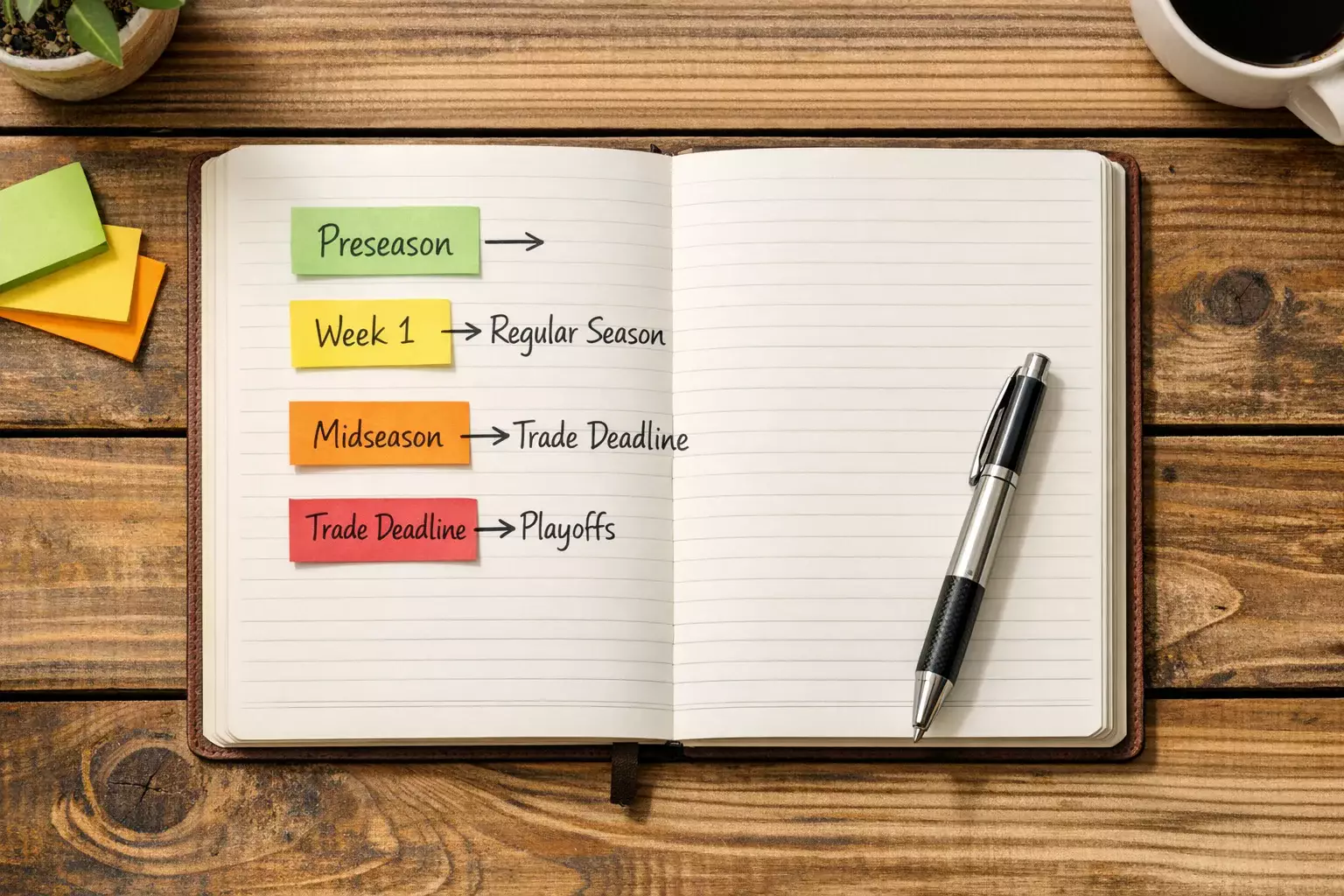
Timing matters enormously in futures betting, and the optimal moment to place your wager depends on your thesis about a particular team. Different points in the calendar offer distinct advantages and disadvantages that strategic bettors learn to exploit.
Preseason futures represent the earliest opportunity to bet, with lines typically released in late summer before training camps open. Betting this early offers the longest odds on favorites and the greatest potential returns if your selection wins. However, preseason betting also carries the most uncertainty. Rosters are not finalized, training camp competitions have not played out, and you have no current-season performance data to analyze. Bettors who bet preseason are essentially projecting based on offseason moves, returning talent, and historical trends. The reward for accepting this uncertainty is better prices than you will find once games begin.
Early season adjustments create the next wave of betting opportunities. After the first month of the season, the market begins separating perception from reality. Teams that looked strong on paper but struggle out of the gate see their odds lengthen, sometimes dramatically. If your analysis suggests a slow start is temporary rather than indicative of true quality, buying at depressed prices can provide tremendous value. Similarly, teams that exceed early expectations might still offer reasonable odds before the market fully adjusts to their improved outlook.
The trade deadline in early March represents another critical inflection point. Contending teams add pieces while rebuilding teams sell, and these moves reshape championship probabilities. A team that acquires a top-six forward or upgrade on defense becomes more dangerous, while a team that loses key contributors becomes less likely to make a deep run. Betting immediately after significant deadline moves allows you to capture value before the market fully prices in the implications of roster changes.
Playoff positioning becomes clear in the final weeks of the regular season, and betting during this period offers the most information but typically the worst prices. You know exactly who made the playoffs, how the brackets are structured, and which teams are healthy entering the postseason. This certainty comes at a cost: favorites are heavily juiced, and longshots have already been eliminated. Some bettors prefer the reduced uncertainty of this timing, accepting worse odds in exchange for clearer information.
Conference and Division Winner Betting
Beyond the Stanley Cup outright market, sportsbooks offer futures on conference and division winners. These markets provide alternative ways to express opinions about team quality without requiring a championship to cash your ticket.
Conference winner bets pay out if your selected team wins the Eastern or Western Conference, meaning they reach the Stanley Cup Final regardless of the ultimate championship result. These bets offer shorter odds than Cup futures since reaching the Final is easier than winning it, but they still provide significant returns on successful longshots. A team at +1200 to win the Cup might be +500 to win their conference, offering a different risk-reward profile that suits certain betting strategies.
The strategic appeal of conference bets involves matchup analysis within each conference. If you believe a team matches up poorly against the likely Cup opponent from the other conference but can dominate their own conference bracket, betting them to win the conference captures value that Cup futures miss. You are essentially betting on 75% of the journey rather than the complete trip, accepting reduced payout for increased probability of cashing.
Division winner markets focus on the regular season rather than playoffs. Winning a division guarantees a top-three seed in the conference, but the bet settles based on regular season standings regardless of playoff performance. This distinction matters because division winners sometimes flame out in the first playoff round while wild card teams make deep runs. Division bets reward regular season excellence specifically, making them suitable for teams you believe will accumulate points consistently but perhaps lack the elite goaltending or depth to survive four playoff rounds.
Division betting also offers hedging opportunities with Cup futures. If you hold a long Cup futures ticket on a team that runs away with their division, you might bet against them in the division market to lock in some profit regardless of how the season ends. This approach reduces your maximum upside but guarantees a positive outcome on at least one of your positions.
Presidents Trophy Betting
The Presidents Trophy goes to the team with the best regular season record across the entire NHL. This market exists separately from division and conference futures because the best regular season team often comes from a stacked division where multiple elite teams cannibalize each other’s records.
Betting the Presidents Trophy requires projecting 82 games of sustained excellence. Unlike playoff betting where hot streaks and goaltending variance dominate outcomes, the regular season rewards consistency and depth. Teams that can weather injuries, manage workloads, and maintain performance through the schedule’s grueling middle months tend to accumulate the point totals necessary to win this award.
Historical patterns reveal that Presidents Trophy winners often share certain characteristics. Elite five-on-five play, strong goaltending tandems that allow rest for the starter, and deep forward groups that can absorb injuries without significant drop-off all correlate with regular season dominance. Special teams matter less than in playoffs because penalty rates normalize over 82 games. Bettors targeting this market should evaluate roster construction through the lens of consistency rather than peak performance potential.
The relationship between Presidents Trophy success and playoff success has been notably weak historically. Multiple Presidents Trophy winners have failed to reach the Stanley Cup Final in the same season, and some have suffered embarrassing first-round exits. This disconnect does not diminish the value of the futures market, but it does mean bettors should treat Presidents Trophy bets as completely separate from Cup analysis. A team can be an excellent regular season investment and a poor playoff investment, or vice versa.
Stanley Cup Playoff Series Betting
Once the playoffs begin, series betting markets open for each matchup. Rather than picking individual game winners, you bet on which team advances from a best-of-seven series. These markets offer distinct value propositions that game betting cannot replicate.
Series prices typically offer better value than parlaying individual game winners because you eliminate the uncertainty of specific game outcomes. If you believe the Colorado Avalanche will beat the Dallas Stars in round one, betting the series at -150 is more efficient than trying to pick the four specific games Colorado wins. The series bet lets Colorado lose games along the way as long as they ultimately prevail.
Series length markets add another dimension to playoff betting. You can bet on exactly how many games a series will last, from four games (a sweep) to seven games (maximum length). These markets require assessing not just who wins but how evenly matched the teams are. Sweeps happen less frequently than casual fans expect, as even heavy underdogs usually steal at least one game in a seven-game series. Six and seven-game series offer plus-money odds that can provide value when you identify closely matched opponents.
Correct series score betting combines winner and length into a single wager. Betting a team to win 4-2 requires them to win exactly four games while their opponent wins exactly two. These bets offer higher payouts than simple series winner bets but require more precision in your prediction. The key is identifying series where you have conviction about both the winner and the approximate competitiveness of the matchup.

Individual Game Betting in Playoffs
Playoff games present different betting dynamics than regular season contests. The intensity increases, referees call games differently, and teams make adjustments between games that regular season scheduling does not allow. Understanding these shifts helps you find value in playoff game markets.
Home ice advantage matters more in playoffs than during the regular season. The crowds are louder, the atmosphere more intense, and home teams tend to perform better in elimination scenarios. Historical data supports fading road teams in playoff games, particularly in Games 5, 6, and 7 when the pressure peaks. This does not mean home teams always win, but the edge is real and should factor into your line assessments.
Goaltending variance increases during the playoffs because the same goaltenders face each other repeatedly. A hot goalie can steal a series almost single-handedly, while a struggling one can sink a more talented team. Monitoring goaltender performance game-to-game within a series reveals whether early results reflect sustainable trends or statistical noise likely to regress. A goalie posting a .960 save percentage through two games will probably decline toward his career average; a goalie at .880 will likely improve.
Rest and scheduling create situational factors unique to playoff game betting. Teams that win series in four or five games enjoy rest advantages over teams that needed six or seven. Back-to-back playoff games are rare but do occur, particularly in later rounds when the league compresses the schedule. Travel between cities affects teams differently based on time zone changes and distance. These logistical factors do not dominate outcomes but provide edges when combined with solid handicapping of the teams themselves.
Playoff Betting Strategies
Beyond understanding individual markets, successful playoff betting requires strategic frameworks that account for the tournament’s unique structure. Several approaches have proven effective for bettors who consistently profit during the postseason.
Contrarian betting often finds value in playoffs because public money heavily backs favorites and popular teams. When the entire market leans one direction, oddsmakers adjust lines to balance their books, sometimes creating value on the unpopular side. If everyone expects a sweep and the series line moves to -250 for the favorite, the underdog at +200 might offer genuine value if the matchup is closer than perception suggests. Fading public consensus requires discipline and conviction, but playoff markets frequently overprice popular narratives.
Chasing steam refers to identifying sharp money movement and following it before lines adjust fully. When a line moves quickly from -130 to -150 without obvious news, professional bettors are likely responsible. These sharps have access to information, models, and analysis that recreational bettors lack. While blindly following steam is not a sustainable strategy, incorporating line movement analysis into your own handicapping can confirm or challenge your initial reads.
Series-based adjustments matter more than single-game analysis because teams adapt to each other throughout a playoff matchup. The team that wins Game 1 does not necessarily hold an advantage in Game 2 because the loser has film to study and can adjust their approach. Monitoring how teams respond to losses, which adjustments they make, and how matchup dynamics evolve game-to-game provides actionable information that pregame betting lines cannot fully capture.
Bankroll segmentation for playoffs helps manage the concentrated betting opportunities. Rather than betting your full regular season unit size on every playoff game, consider allocating a specific playoff bankroll and sizing bets appropriately for the reduced sample size. The playoffs feature roughly 85 games total compared to over 1,300 regular season games. Higher variance demands adjusted stake sizing to survive the inevitable losing stretches.
Historical Trends and Patterns
Studying historical playoff patterns reveals tendencies that inform current betting decisions. While past results do not guarantee future outcomes, certain trends have persisted long enough to warrant consideration in your analysis.
Lower seeds win more often than casual observers expect. Since the NHL expanded to 32 teams and adopted the current playoff format, wild card teams have regularly made deep runs and occasionally won the Stanley Cup. The parity created by the salary cap means talent gaps between playoff teams are smaller than in other sports. Betting significant underdogs in series markets can be profitable when the market overvalues regular season seeding.
Goaltending tends to determine playoff success more than regular season performance predicts. Teams with elite goaltenders who elevate their games in the postseason consistently outperform their regular season results. Conversely, teams that rely on depth scoring and system play sometimes struggle when playoff officiating tightens and goals become harder to produce. Identifying which goaltenders have historically performed in playoffs versus which ones have struggled provides valuable context for futures and series betting.
The defending champion faces unique challenges that affect their futures value. Fatigue from a long previous postseason, target status from opponents, and potential complacency all work against repeat champions. Since the salary cap era began, back-to-back Stanley Cup winners have been extremely rare. This historical pattern suggests fading defending champions in futures markets, at least at the short prices the market typically assigns them.
Travel and conference structure create patterns worth noting. Teams from the Pacific Division must travel further in early playoff rounds, potentially creating fatigue disadvantages in later rounds. Eastern Conference teams generally face shorter travel distances throughout the playoffs. While these effects are small, they accumulate over a two-month tournament and might explain some of the historical variance between conferences.
Player Award Futures
Beyond team-based futures, sportsbooks offer markets on individual player awards. The Hart Trophy (MVP), Vezina Trophy (best goaltender), Norris Trophy (best defenseman), Calder Trophy (best rookie), and Conn Smythe Trophy (playoff MVP) all feature futures betting throughout the season.
Hart Trophy betting requires identifying which player the voting writers will deem most valuable to his team. This award traditionally goes to the best player on a good team rather than the statistically superior player on a mediocre one. A 100-point scorer whose team misses the playoffs rarely wins over an 85-point scorer whose team finishes first in their division. Betting the Hart requires projecting both individual performance and team success, making it one of the more complex futures markets.
The Vezina Trophy rewards the best goaltender as voted by general managers. Statistical performance matters, but so does team success and narrative. A goaltender with excellent numbers on a bad team faces an uphill battle against one with slightly worse numbers on a contender. Win totals, save percentage, and goals against average all factor into voting, with voters generally favoring goaltenders who played heavy workloads over those who split time significantly with backups.
Conn Smythe futures represent the most volatile player award market because they depend entirely on playoff performance. A player who dominates the regular season might flame out in round one, making his Conn Smythe ticket worthless. Conversely, relatively unknown players can emerge during playoff runs and win the award at enormous odds. Betting Conn Smythe requires identifying players likely to both reach the later playoff rounds and perform at an elite level once there.
Calder Trophy betting focuses on first-year players, creating a market with significant uncertainty since many top rookies have limited NHL track records. Preseason favorites often disappoint while unexpected contributors emerge. Patience is essential in this market, as early season small samples mislead more than inform. Waiting until 20-30 games into the season provides more reliable data while still offering reasonable odds on emerging candidates.
Hedging Your Futures Bets
One significant advantage of futures betting is the ability to hedge positions as circumstances change. Hedging involves placing bets against your original position to guarantee profit or minimize loss regardless of the final outcome. Mastering hedging strategies maximizes the value you extract from winning futures tickets.
The basic hedge occurs when your futures selection reaches the Stanley Cup Final. If you bet a team at +2000 preseason and they reach the Final, you have a ticket worth significant money that could become worthless if they lose. Betting their opponent on the series line guarantees profit: if your original team wins, you collect your futures payout minus the hedge loss; if they lose, you collect your hedge payout minus the futures loss. Calculating the optimal hedge amount ensures positive outcomes regardless of the result.
Progressive hedging throughout the playoffs offers more sophisticated profit-taking opportunities. Rather than waiting until the Final, you can hedge after each series your team wins. This approach locks in smaller profits along the way rather than gambling everything on the ultimate outcome. The tradeoff involves leaving money on the table if your team wins the Cup, but it also protects against the heartbreak of watching a long futures position die in the third round.
Deciding whether to hedge involves assessing your risk tolerance and the value available. If you believe your team is the best remaining and likely to win the Cup, letting your bet ride might offer better expected value than hedging at unfavorable prices. If you are nervous about variance or need the guaranteed profit, hedging makes sense. There is no objectively correct answer since the right choice depends on your personal circumstances and betting goals.
Live hedging during games adds another dimension for active bettors. If your futures team falls behind in an elimination game, you can bet the opponent on the live moneyline to hedge against elimination. This real-time adjustment requires quick decision-making and access to live betting markets, but it provides flexibility that pregame hedging cannot match.

Building a Futures Portfolio
Sophisticated bettors approach futures not as individual bets but as a portfolio requiring balance and diversification. Rather than betting a single team to win the Cup, spreading action across multiple selections at different price points manages risk while maintaining upside potential.
Portfolio construction begins with identifying value rather than simply picking winners. A team at +1500 might represent better value than a favorite at +400 even if the favorite is more likely to win. Your goal is finding bets where the odds exceed true probability, not simply backing the best teams. A portfolio might include two or three longshots with genuine paths to the Cup alongside a shorter-priced selection you believe the market undervalues.
Staggering entry points across the season allows you to capture value at different times. You might bet one selection preseason, add another after a month of games, and place a third bet at the trade deadline. This approach provides information advantages for later bets while still capturing the best prices available early. It also protects against putting all your futures capital into preseason bets that lose value immediately if a team starts poorly.
Monitoring your portfolio throughout the season allows for adjustments as information emerges. If one of your longshots suffers a major injury to their starting goaltender, you might write off that position rather than adding to it. If another selection exceeds expectations and their odds shorten significantly, you might take profits through hedging while still maintaining some exposure. Active management maximizes the value you extract from futures positions rather than simply placing bets and hoping.

Conclusion
Stanley Cup futures and playoff betting offer some of the most engaging wagering opportunities in sports. The extended timeline rewards patient analysis, the playoff intensity creates memorable betting moments, and the variety of available markets allows bettors to express their views in multiple ways. Whether you prefer locking in a preseason longshot and waiting eight months or actively betting every playoff game, opportunities exist throughout the NHL calendar.
Success in these markets requires understanding their unique characteristics. Futures odds move constantly, so timing your bets matters as much as selecting the right teams. Playoff dynamics differ fundamentally from regular season betting, demanding adjusted strategies that account for increased variance and situational factors. Hedging provides tools to manage risk and lock in profits that single-game betting cannot match.
The strategies and frameworks in this guide provide a foundation for approaching Stanley Cup betting intelligently. Apply them to your own analysis, track your results, and refine your approach based on what works. The Cup is the hardest trophy to win in professional sports, and betting on it successfully requires respecting that difficulty while finding the edges the market provides. For those who put in the work, few betting experiences match watching your futures selection hoist the Stanley Cup knowing you identified their potential months before anyone handed them the trophy.
Stanley Cup betting at hockey betting.
