
How to Read NHL Betting Odds
 Available in US
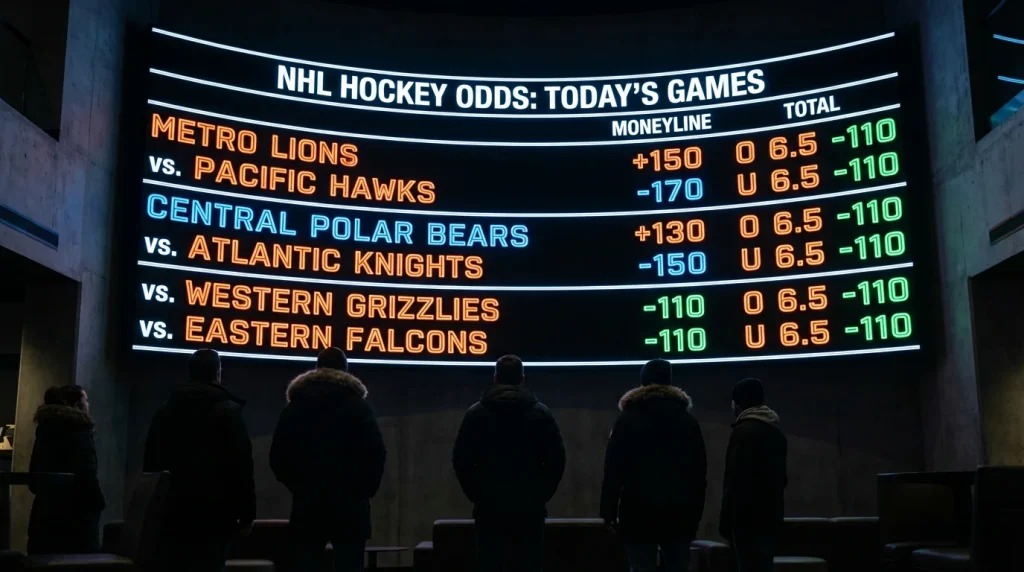
Odds are the language of sports betting. Every number on the board is a sentence that tells you how likely the sportsbook thinks an outcome is and how much you stand to profit if you are right. If you cannot read odds fluently, you are placing bets without understanding what you are buying — the equivalent of signing a contract in a language you do not speak. The good news is that odds are not complicated once you learn the grammar. Three formats dominate the global betting market, and every NHL line you will ever encounter uses one of them.
See also NHL moneyline betting explained.
American Odds
American odds are the default format at North American sportsbooks and the one most NHL bettors encounter first. They are expressed as positive or negative numbers centered around $100. A negative number tells you how much you must risk to profit $100. A positive number tells you how much you profit on a $100 wager.
If the Toronto Maple Leafs are listed at -140, you need to bet $140 to win $100 in profit. If they are listed at +120, a $100 bet returns $120 in profit. The favorite always carries the minus sign, the underdog carries the plus sign, and the size of the number reflects how strongly the market favors one side over the other.
The deeper the negative number, the heavier the favorite. A team at -300 is a massive favorite — you risk $300 to win $100. A team at -110 is barely favored — you risk $110 to win $100. On the underdog side, the higher the positive number, the longer the shot. A +400 underdog returns four times your stake, while a +110 underdog returns just slightly more than even money.
American odds feel intuitive once you have placed a few bets, but they have a quirk that trips up beginners: the numbers are not symmetrical. A game with a -150 favorite and a +130 underdog does not mean the probabilities are equal and opposite. The gap between those two numbers represents the sportsbook’s margin, which we will cover in the implied probability section. For now, understand that every pair of American odds contains a built-in fee that ensures the book profits over time.
Decimal Odds
Decimal odds are the standard in Europe, Canada, and Australia, and most international sportsbooks offer them as an option. They express the total return on a $1 bet, including your original stake. If the Maple Leafs are listed at 1.71 in decimal odds, a $1 bet returns $1.71 total — $1 of your original stake plus $0.71 in profit.
Converting between American and decimal is straightforward. For a negative American line, divide 100 by the absolute value of the number and add 1. So -140 becomes (100 / 140) + 1 = 1.714. For a positive American line, divide the number by 100 and add 1. So +120 becomes (120 / 100) + 1 = 2.20.
The advantage of decimal odds is clarity. Comparing two bets is effortless: the higher the decimal number, the bigger the payout. There is no need to perform different mental calculations for favorites versus underdogs, no sign changes, no confusion about whether a number represents risk or reward. A bet at 3.50 pays more than a bet at 2.10, and that is the entire story.
For NHL bettors who use multiple sportsbooks — particularly those with accounts at both North American and European platforms — fluency in decimal odds is essential. Many line comparison tools display odds in decimal format by default, and the ability to scan a row of decimal prices and instantly identify the best value saves time and eliminates conversion errors.
Fractional Odds
Fractional odds are the traditional format in the United Kingdom and Ireland, though they appear less frequently in North American hockey markets. They are expressed as a fraction — 7/5, for example — where the first number is the profit and the second is the stake. A bet of $5 at 7/5 returns $7 in profit plus the original $5 stake.
The Maple Leafs at -140 American translate to roughly 5/7 in fractional format: you stake $7 to profit $5. The underdog at +120 translates to 6/5: you stake $5 to profit $6. These conversions are rarely exact because fractional odds stick to clean fractions while American and decimal odds offer finer granularity, but the approximation is close enough for practical purposes.
Most NHL bettors in North America will rarely encounter fractional odds outside of the occasional European sportsbook or a futures market that uses traditional formatting. Understanding the format is useful for completeness, but decimal and American are the two you will use daily.
Implied Probability: The Number Behind the Number
Every set of odds corresponds to an implied probability — the percentage chance the sportsbook assigns to that outcome occurring. This is the most important concept in odds reading, because it transforms abstract numbers into something you can compare against your own assessment of the game.
To calculate implied probability from American odds, use these formulas. For a negative line: divide the absolute value of the odds by (the absolute value plus 100). For -140, that is 140 / (140 + 100) = 0.583, or 58.3%. For a positive line: divide 100 by (the odds plus 100). For +120, that is 100 / (120 + 100) = 0.455, or 45.5%.
For decimal odds, the calculation is even simpler: divide 1 by the decimal odds. At 1.71, the implied probability is 1 / 1.71 = 0.585, or 58.5%. At 2.20, it is 1 / 2.20 = 0.455, or 45.5%.
Notice that the implied probabilities for both sides of a game add up to more than 100%. In the example above, 58.3% plus 45.5% equals 103.8%. That extra 3.8% is the sportsbook’s margin — the overround or vig. It is the built-in edge that ensures the book profits regardless of which team wins. Every bet you place includes this hidden tax, and understanding it is essential for evaluating whether a line offers genuine value.
The smaller the vig, the more of the true probability you are capturing. A sportsbook that posts -105 on both sides of a bet is charging less margin than one posting -110 on both sides. Over hundreds of bets, this difference is significant. A 5% vig costs you roughly half as much as a 10% vig over the same volume, which is why sharp bettors obsess over finding the tightest lines available.
Implied probability also serves as a sanity check on your handicapping. If you believe a team has a 60% chance of winning and the sportsbook’s implied probability is 55%, the line offers value — you are getting better odds than the outcome warrants. If the sportsbook’s implied probability is 63%, the line is overpriced and you should pass. This comparison between your estimated probability and the market’s implied probability is the fundamental decision framework of sports betting.
Comparing Odds Across Formats and Books
Line shopping — comparing odds at multiple sportsbooks to find the best price — is one of the simplest and most effective ways to improve your long-term results. Different books post different odds on the same game, and the differences can be meaningful. One sportsbook might list a team at -145 while another has them at -135. That 10-cent difference might seem trivial on a single bet, but over 500 bets in a season, consistently taking the better price adds up to several units of profit.
To compare odds effectively across formats, convert everything to either implied probability or decimal odds. Implied probability is the most useful because it lets you directly compare the sportsbook’s price to your own estimate of the outcome. If Book A offers -135 (implied 57.4%) and Book B offers -150 (implied 60%), and you believe the true probability is 58%, Book A is giving you value while Book B is not.
Several free tools aggregate odds from multiple sportsbooks in real time, displaying the best available line for each side of a game. These tools are indispensable for serious bettors because they eliminate the need to manually check six or seven sportsbook apps before placing each wager. Bookmark one, use it before every bet, and make line shopping a non-negotiable part of your process.
The habit of comparing odds also teaches you to recognize when a line is moving. If most books have a team at -130 but one book still has them at -120, either the outlier has not updated its line or it has a different view of the game. Either way, the -120 is a better price, and acting on it before it moves is the essence of value betting.
Numbers That Talk
Odds are not arbitrary. They are the sportsbook’s opinion expressed in mathematical form — a statement about how likely every outcome is, filtered through a margin that ensures the house survives regardless of the result. Learning to read that statement, translate it into probability, and compare it against your own analysis is the foundational skill of betting.
You do not need to be a mathematician. You need to understand three formats, one conversion formula, and one comparison: your probability versus the market’s probability. Everything else in hockey betting — the analytics, the goaltender tracking, the schedule analysis — feeds into that single comparison. Get comfortable with the numbers, and every other piece of your betting education becomes more useful, more grounded, and more profitable.
How to read NHL betting odds at hockey betting.
