
NHL Player Prop Bets: Complete Guide
 Available in US
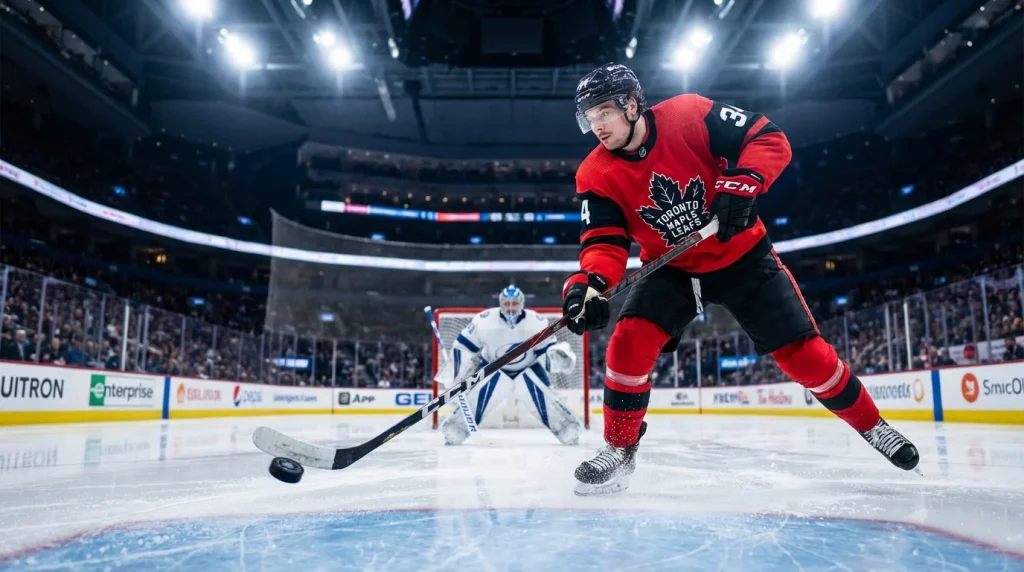
Player props let you bet on individual performance instead of team outcomes. You are not picking who wins or how many goals the game produces — you are betting on whether a specific skater hits a shots target, whether a goalie makes enough saves, or whether a top-line forward finds the back of the net. It is a market that rewards deep knowledge of rosters, line combinations, and matchups more than any other bet type in hockey. If you know the sport at a granular level, props are where that knowledge pays off.
See also the NHL player props guide.
What Player Props Are and Why They Matter
A player prop is a wager tied to an individual player’s statistical output in a single game. Sportsbooks set a line — say, Connor McDavid over/under 3.5 shots on goal — and you bet on whether the actual number lands above or below it. The beauty of this market is its specificity: you are not forecasting an entire game, just one player’s activity within it.
The most common NHL player prop categories include goals, assists, points, shots on goal, and blocked shots for skaters, plus saves and goals allowed for goaltenders. Some books expand into more exotic territory — hits, faceoff wins, power-play points, first goal scorer, and anytime goal scorer — but the core markets revolve around the stats that are tracked most reliably and appear on every major sportsbook.
Props matter to bettors because they offer a path to edge that team-level markets often do not. Sportsbooks invest enormous resources into setting accurate moneylines and totals, and the market is efficient as a result. Player props, by contrast, are set with less precision. The lines are generated algorithmically and adjusted with less liquidity than main markets, which means informed bettors can find discrepancies that simply do not exist on the moneyline or puck line.
Goals, Assists, and Points Markets
The anytime goal scorer market is one of the most popular player props in hockey. You are betting on whether a specific player scores at least one goal during the game. Top-line forwards typically sit between +120 and +200 depending on their scoring rate and the matchup, while depth players may be priced at +300 or higher. The math is straightforward: a player who scores in roughly 35% of his games should be priced around +185. If the book is posting +220, there is value on the over.
Assist and point props work similarly but with different hit rates. Elite playmakers like those centering the top power-play unit record at least one assist in a higher percentage of games than they score goals, which means assist props often sit at tighter odds. Points combine goals and assists, and the over on a points prop is the easiest to hit for truly elite players — someone logging 1.3 points per game historically clears 0.5 points in a large majority of his appearances.
The key variable in these markets is deployment. A forward playing 20 minutes per night on the first line and the top power play has far more opportunity to produce than the same player would with reduced ice time. Track line combinations and power-play units closely, especially early in the season when coaches are still experimenting. A promotion from the second line to the first can shift a player’s goal probability meaningfully, and the sportsbook may not adjust the prop line fast enough to account for the change.
Shots on Goal and Peripheral Props
Shots on goal is the workhorse of the player prop market. The lines are typically set at 2.5 or 3.5, and the odds adjust based on the player’s shooting volume, the opponent’s shot suppression ability, and the game’s expected pace. High-volume shooters — players who consistently put four or five pucks on net per game — are the most predictable props on the board, because shot volume is one of the stickiest statistics in hockey. A player who averages 4.1 shots on goal per game is going to hover near that number night after night, regardless of whether he scores.
Blocked shots and hits are available on most major sportsbooks, though these markets carry more variance. A defenseman who averages 2.0 blocked shots per game might post zero in a game where his team dominates possession and the opponent barely shoots, or he might block four in a game where they are defending a lead. The distribution is chunkier than shots on goal, which makes these props harder to model and riskier to bet consistently.
That said, blocked shot and hit props can offer value in specific situations. A physical defenseman facing a high-volume shooting team is likely to see more rubber than usual, and a power forward matched against a skill-oriented opponent who avoids contact may rack up hits. The edge here comes from matchup awareness, not seasonal averages.
Goaltender Props
Goalie props are a separate animal. The most common is saves, with lines typically set between 24.5 and 30.5 depending on the matchup. A goaltender facing a high-volume shooting team will have a higher saves line, while one facing a low-event opponent sits lower. The logic is intuitive: more shots faced means more saves, even if the goalie is performing at an average level.
The wrinkle is that saves are a function of both workload and game script. A goaltender whose team falls behind early is likely to face more shots as the opponent presses the advantage, which pushes saves higher. A goaltender on a dominant team that controls possession may face only 20 shots and finish with 18 saves, well below a line set at 26.5. This means saves props are not purely about goaltender quality — they are about expected shot volume against, which depends on team strength, pace, and game flow.
Goals allowed is the other common goalie prop. Lines sit at 2.5 or 3.5, and the under tends to be heavily juiced for elite starters. This market is tighter and harder to find value in, because sportsbooks are well aware of which goaltenders suppress goals and price accordingly. The occasional value appears when a strong goaltender faces a team whose offensive reputation exceeds their underlying shot quality — a team that looks dangerous on the scoresheet but generates most of its goals from low-probability chances and power-play opportunities.
Finding Value in the Props Market
The props market rewards specialization. You do not need to bet every player in every game. In fact, trying to do so is a guaranteed way to bleed money. The bettors who profit from props focus on a subset of players they understand deeply — their usage patterns, their matchup tendencies, their performance in specific game states — and only bet when the line deviates from their model.
One reliable edge comes from tracking lineup changes that the sportsbook has not yet incorporated. When a coach shuffles his lines mid-week, moving a second-line winger to the top line or swapping power-play personnel, the prop lines may lag behind by a day or more. If you follow team beat reporters and monitor practice lines, you will occasionally spot a player whose prop line reflects his old role rather than his new one. These windows are small but profitable.
Another angle is opponent-specific analysis. Some teams allow significantly more shots from the slot than others, which inflates the goal-scoring probability for opposing forwards. If a top-six forward who averages 0.3 goals per game is facing a team that allows the most high-danger chances in the league, his anytime goal scorer line should be shorter than his season average suggests. If it is not, the over has value.
Discipline is everything in props. The market posts hundreds of lines every night, and the temptation to bet on volume is real. Resist it. A focused approach — five to eight well-researched props per week rather than twenty rushed ones per night — is the path to sustainable profitability. Every prop you bet without a clear edge is a prop where the house edge works against you.
The Prop Bettor’s Toolkit
Player props transform you from a spectator into a scout. You start watching shifts instead of periods, tracking zone entries instead of goals, and noticing which defensemen pinch on the power play versus which ones hang back at the point. This granular attention is not just useful for betting — it fundamentally changes how you experience hockey.
The players who move the needle in the props market are not always the stars. A third-line center who wins 58% of his faceoffs and consistently logs two blocked shots per game is invisible to most fans but visible to the bettor who knows where to look. A backup goaltender making a spot start against a team that has been struggling to generate offense is a prop opportunity hiding in plain sight.
What makes this market unique is that it does not care about the final score. Your team can lose 5-1 and your player props can still cash. That independence from game outcome is liberating for bettors who are tired of watching a dominant performance evaporate because of a bad bounce or an empty-net goal. In props, the player is the market, and the rest of the game is background noise.
NHL player prop bets guide at hockey betting.
