
NHL Line Shopping: How to Find the Best Odds
 Available in US
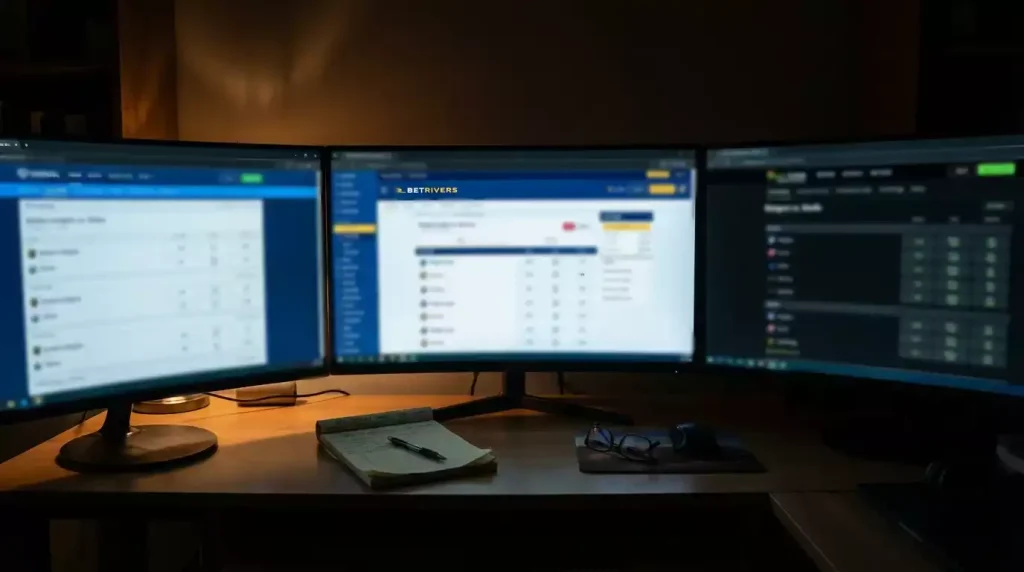
Line shopping is the closest thing to free money in sports betting. Every cent you save by taking a better price is a cent added directly to your bottom line — no handicapping required, no risk involved, no analysis needed beyond comparing two numbers and picking the larger one. Yet the majority of NHL bettors skip this step entirely, placing every wager at whichever sportsbook they happen to have open. That laziness has a measurable cost, and over a full season it is the difference between a bettor who grinds a profit and one who donates to the vig.
See also how to choose an NHL sportsbook.
Why Line Shopping Matters
Different sportsbooks post different odds on the same game. This is not a secret, and it is not an error — it is the natural result of each book managing its own risk exposure, responding to different customer bases, and using different models to set its lines. One book might have the Tampa Bay Lightning at -140 while another has them at -130. Both prices are “correct” from each book’s perspective, but from your perspective, -130 is objectively better.
The difference between -140 and -130 feels small on a single bet. At -140, you risk $140 to win $100. At -130, you risk $130 to win $100. You save $10 in risk for the same $100 reward. Over one bet, that is a rounding error. Over 500 bets, it is $5,000 in reduced risk — which, depending on your unit size, could represent 25 to 50 units of bankroll preserved. That is not a marginal improvement. That is a structural advantage.
The cumulative impact of line shopping has been studied extensively, and the consensus is clear: bettors who consistently take the best available odds improve their return on investment by 2-4% compared to those who bet at a single book. For a bettor with a 53% win rate at -110, that improvement can be the gap between a losing season and a profitable one. Line shopping does not make you a better handicapper, but it makes your handicapping go further.
The effect is amplified in markets where the vig is wider. Player props, for example, often carry a larger margin than moneylines, which means the price dispersion across books is also larger. One book might offer a player shots prop at -120 while another offers the same prop at -105. That 15-cent difference on a prop bet is enormous, and the bettor who compares before placing captures the better price every time.
How Cents Add Up Over a Season
To understand the long-term impact of line shopping, consider a bettor who places 400 bets during an NHL season with an average unit of $50. If they consistently take prices that are 5 cents better than the alternative — betting at -130 instead of -135, for example — the savings on each losing bet average roughly $1.50 to $2.00 (because the risk amount is lower). Over 400 bets, with an assumed loss rate of 47%, that bettor saves approximately $280 to $380 across the losing bets alone. On the winning side, the better price sometimes means slightly higher payouts, adding another layer of improvement.
That $300+ in savings is pure value captured from the market without placing a single additional bet or taking on any additional risk. It is the equivalent of winning six to eight extra bets at standard sizing, generated entirely by the habit of checking a second screen before clicking the confirm button.
The savings compound further when you factor in reduced-juice books. A sportsbook that offers -105 instead of -110 on standard markets is giving you 5 cents on every bet. If you can access a reduced-juice book for even a portion of your wagers, the season-long benefit is substantial. Mixing a reduced-juice primary book with standard books for supplementary action is a common approach among professionals, and the arithmetic makes it obvious why.
Tools and Process
Line shopping does not require manually checking six different apps before every bet. Several free platforms aggregate odds from major sportsbooks in real time, displaying the best available price for each side of every NHL game. These tools update as lines move, which means you can see not only the current best price but also how the line has shifted since opening.
The workflow is simple. Identify the game and bet type you want. Open your odds comparison tool. Find the sportsbook offering the best price on your side. Place the bet at that book. The entire process adds 30-60 seconds to each wager, and the return on that time investment is extraordinary.
If you do not have accounts at multiple sportsbooks, the first step is to open them. Three or four accounts is sufficient for meaningful line shopping; five or six gives you broader coverage. Fund each account with enough capital to place your standard wagers, and rebalance periodically by withdrawing from books you use less frequently and depositing into your most-used platforms. The administrative overhead is modest and well worth the return.
When Line Shopping Matters Most
Line shopping is always beneficial, but its impact is not uniform across all bet types and situations. Some markets offer wider price dispersion than others, which means the payoff from shopping is larger in those markets.
Moneyline underdogs are the market where line shopping tends to yield the biggest returns. When a team is priced at +150 at one book and +165 at another, the 15-cent difference represents a significant improvement in payout. A $50 bet at +150 returns $75 in profit. The same bet at +165 returns $82.50. Over the course of a season, those extra $7.50 payouts on winning underdog bets accumulate into multiple units of additional profit. Because underdogs pay more per dollar risked, even small price improvements translate into meaningful dollar amounts.
Heavy favorites show less price dispersion because sportsbooks are more closely aligned on obvious mismatches. A team at -250 at one book is unlikely to be -210 at another — the gap is usually 5-10 cents at most. The savings are real but smaller on a per-bet basis. Line shopping still matters for favorites, but the return on the effort is lower than for underdogs.
Totals and puck lines often show interesting dispersion because different books respond to public money and sharp money at different speeds. A total that opens at 6 across the market may move to 6.5 at one book while staying at 6 at others, depending on how the action flows. Getting the better number — 6 instead of 6.5 — is not a price improvement, it is an entirely different bet. Half a goal in hockey is the difference between a push and a loss on a significant percentage of games, and grabbing the better number is worth more than any price savings on the odds.
Props are the widest market for line shopping. Sportsbooks set player prop lines with less precision than main markets, and the variance in both lines and odds across books is substantial. One book might offer a player’s shots on goal over 2.5 at -120 while another has the same market at -105. That 15-cent difference, multiplied across dozens of prop bets over a season, is one of the most efficient sources of value available to the disciplined bettor.
Building the Line Shopping Habit
The hardest part of line shopping is not the process — it is the discipline. When you see a game you want to bet, the impulse is to place the wager immediately at whatever book you have open. Fighting that impulse and spending 30 seconds checking other books feels like a delay, especially if you are betting during a live game or reacting to breaking news. But that 30-second delay is the highest-return activity in your entire betting process.
Start by making line shopping the default. Before you place any bet, check at least one other book. This simple rule — never bet without a comparison — builds the habit faster than any more complex system. After a week, it becomes automatic. After a month, betting without shopping feels as wrong as betting without checking the goaltender.
Keep your sportsbook apps organized. Place them next to each other on your phone’s home screen, or use a browser with bookmarked tabs for each book’s NHL page. Reduce the friction between deciding to bet and comparing prices, and the habit sustains itself.
Track your line shopping savings. In your bet-tracking spreadsheet, add a column for the best available price and another for the price you actually took. At the end of each month, calculate the difference. Seeing a concrete dollar amount — “$175 saved this month by line shopping” — reinforces the behavior and proves its value in terms your bankroll can feel.
If you are serious about line shopping, consider setting up alerts through odds-monitoring services that notify you when a line moves past a threshold you define. If you want the Maple Leafs at +140 or better and the line is currently +130, an alert saves you from checking repeatedly and lets you act the moment the price hits your target.
The Simplest Edge
Line shopping is not glamorous. It does not require advanced analytics, proprietary models, or inside information. It requires patience, discipline, and 30 extra seconds per bet. That modesty is precisely why so many bettors skip it — it does not feel like an edge because it does not require any expertise.
But the math does not care about feelings. The math says that consistently taking the best available price improves your return on investment by a measurable amount over a meaningful sample. The math says that the bettor who shops every line will outperform an identically skilled bettor who does not, purely because of the prices they pay. And the math says that over an NHL season with hundreds of bets, those accumulated cents become dollars, and those dollars become the margin between a winning year and a losing one. If you do nothing else to improve your betting, do this.
NHL line shopping guide at hockey betting.
